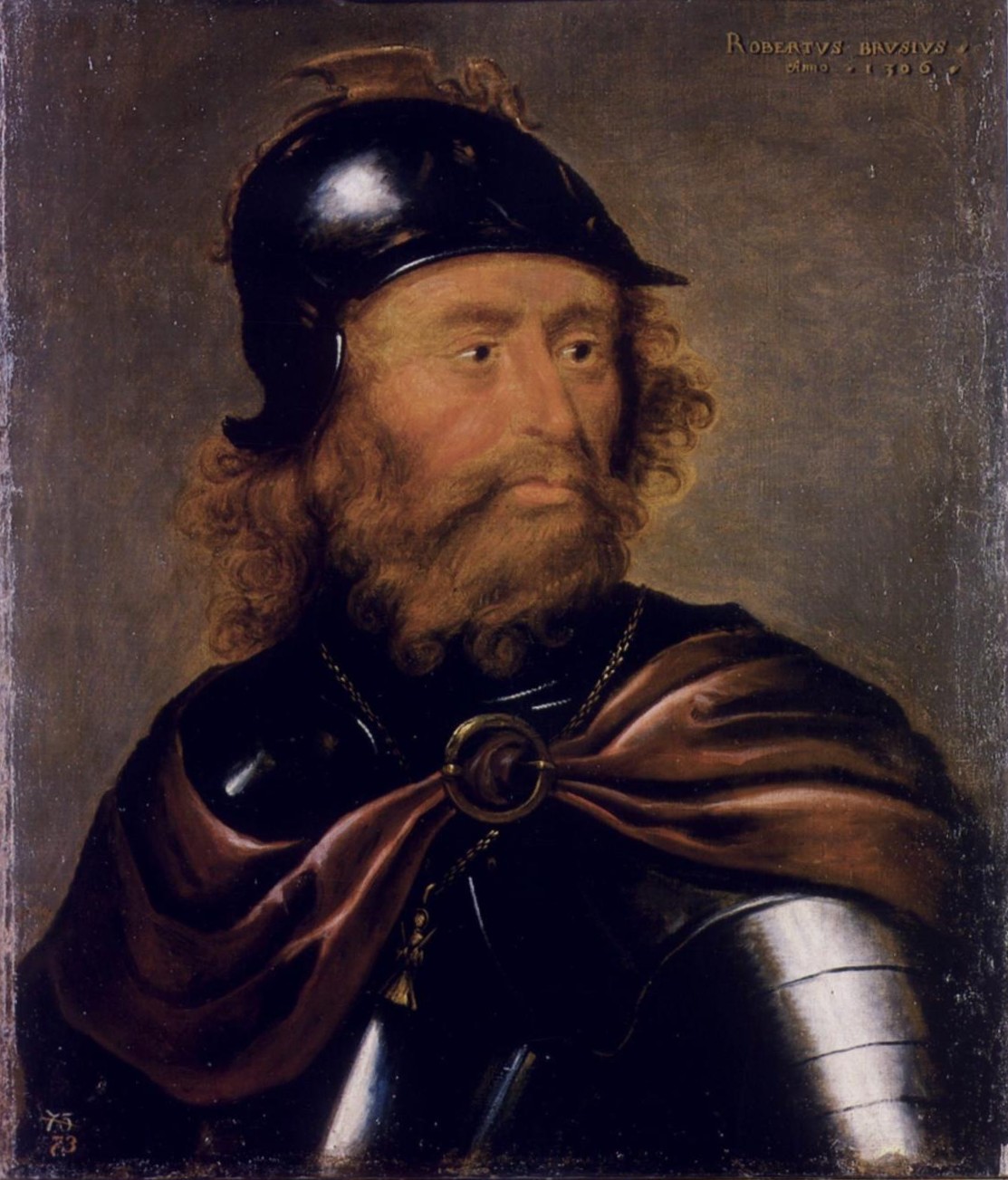
King Robert THE BRUCE of Scots 2157
- Born: 11 July 1274, Turnberry, , Ayrshire, Scotland 2157
- Christened: 7 November 1274, Dundee, , Angus, Scotland 2157
- Marriage (1): Isabella OF MAR in 1296 2159
- Marriage (2): Queen Elizabeth DE BURGH of Scots in 1302 in Writtle, , Essex, England 2159
- Died: 7 June 1329, Cardross, Dunbartonshire, Argyll and Bute, Scotland at age 54 2157
- Buried: 23 June 1329, Dunfermline, , Fife, Scotland 2157
FamilySearch ID: LDQR-3KB
Find A Grave ID: 286249068
Burial Notes:
Embalmed Viscera (organs in the cavities of the body, especially abdominal cavity).
Robert the Bruce was King of Scots from 1306 until his death in 1329.
["The earliest reference to St Serf's Church at Cardross occurs in a 13th century charter whereby the Earl of Lennox granted the income to the Bishop of Glasgow (1208-33). In the early 14th century this was the parish church for Robert I's manor nearby at Cardross. The Rector of Cardross played an important part in the funeral arrangements of Robert I in 1329, and a tradition emerged as early as the 17th century that the viscera of the Robert I were buried in this church following his embalming.
["The monument is of national importance because of the potential of the upstanding structure to contribute to our understanding of medieval ecclesiastical architecture. Its below-ground remains have the potential through excavation to add significantly to our knowledge of the historical evolution of church building on the site, as well as contributing to our knowledge of medieval life through the skeletal remains likely to be buried here. Moreover, the site has the potential to feature in the national consciousness due to its historical function during the life and death of Robert I."
Source : Explore West Dunbartonshire - ST SERF'S CHURCH, Levengrove Park.
Scheduled Monument - Kirktonhill Conservation Area.]
Gravesite Details
Dunfermline Abbey (Body) - Memorial ID 2894
Melrose Abbey (Heart) - Memorial ID 286248796
St Serf's Church, Dumbarton (Embalmed Viscera) - Memorial ID 286249068
Noted events in his life were:
1. He was Catholicism. 2159
2. He worked as a Guardian of the Kingdom of Scotland (Regent) between 1298 and 1300 in , , , Scotland. 2159 Guardians of Scotland were Regents who governed the Kingdom of Scotland when the true king was underaged or otherwise incapable of governing. Bruce was a Guardian from 1298 to 1300, along with John Comyn III and William de Lamberton.
3. Title of Nobility: King of Scotland, between 1306 and 1329, in Old Scone, Cargill, Perth and Kinross, Scotland. 2159 (Scone Abbey, Old Scone, Perthshire, Scotland.)
4. Robert served in the military between July 1327 and August 1327 in Weardale, , Durham, England: Weardale Campaign. In 1327 Edward III led his first military campaign in Weardale. The so-called Weardale campaign against the Scots was a military failure but led to the politically important Treaty of Edinburgh\endash Northampton. The campaign was graphically described by a participant, the chronicler Jean Le Bel.
Scottish victory. The Weardale campaign, part of the First War of Scottish Independence, occurred during July and August 1327 in Weardale, England. A Scottish force under Lord Douglas and the earls of Moray and Mar faced an English army commanded by Roger Mortimer, 3rd Baron Mortimer, accompanied by the newly crowned Edward III. In 1326 the English king, Edward II, was deposed by his wife, Isabella, and her lover, Mortimer. England had been at war with Scotland for 30 years and the Scots took advantage of the chaotic situation to launch large raids into England. Seeing opposition to the Scots as a way of legitimising their position, Isabella and Mortimer prepared a large army to oppose them. In July 1327 they set off from York to trap the Scots and force them to battle. After two weeks of poor supplies and bad weather the English confronted the Scots when the latter deliberately gave away their position. The Scots occupied an unassailable position immediately north of the River Wear. The English declined to attack it and the Scots declined to fight in the open. After three days the Scots moved overnight to an even stronger position. The English followed them and, that night, a Scottish force crossed the river and successfully raided the English camp, penetrating as far as the royal pavilion. The English believed that they had the Scots surrounded and were starving them out, but on the night of 6 August the Scottish army escaped and marched back to Scotland. The campaign was ruinously expensive for the English. Isabella and Mortimer were forced to negotiate with the Scots and in 1328 the Treaty of Edinburgh\endash Northampton was signed, recognising Scottish sovereignty.
.
5. Treaty: The Treaty of Edinburgh–Northampton, on 17 March 1328, in Edinburgh, Edinburgh, Midlothian, Scotland. The Treaty of Edinburgh\endash Northampton was a peace treaty signed in 1328 between the Kingdoms of England and Scotland. It brought an end to the First War of Scottish Independence, which had begun with the English party of Scotland in 1296. The treaty was signed in Edinburgh by Robert the Bruce, King of Scots, on 17 March 1328, and was ratified by the Parliament of England meeting in Northampton on 1 May. The terms of the treaty stipulated that in exchange for £100,000 sterling, the English Crown would recognise: The Kingdom of Scotland as fully independent; Robert the Bruce, and his heirs and successors, as the rightful rulers of Scotland; The border between Scotland and England as that recognised under the reign of Alexander III.
6. Clan: Bruce,,.
Robert married Isabella OF MAR in 1296.2159 (Isabella OF MAR was born in 1277 in Kildrummy, , Aberdeenshire, Scotland 2157, christened in 1277 in Kildrummy, , Aberdeenshire, Scotland,2157 died on 12 December 1296 in Cardross, Dunbartonshire, Argyll and Bute, Scotland 2157 and was buried on 12 December 1296 in Paisley, , Renfrewshire, Scotland 2157.)
Robert next married Queen Elizabeth DE BURGH of Scots in 1302 in Writtle, , Essex, England.2159 (Queen Elizabeth DE BURGH of Scots was born in 1289 in , Down, Ulster, Northern Ireland,2159 died on 27 October 1327 in Cullen, Banffshire, Moray, Scotland 2159 and was buried in 1327 in Dunfermline, , Fife, Scotland 2159.)
|