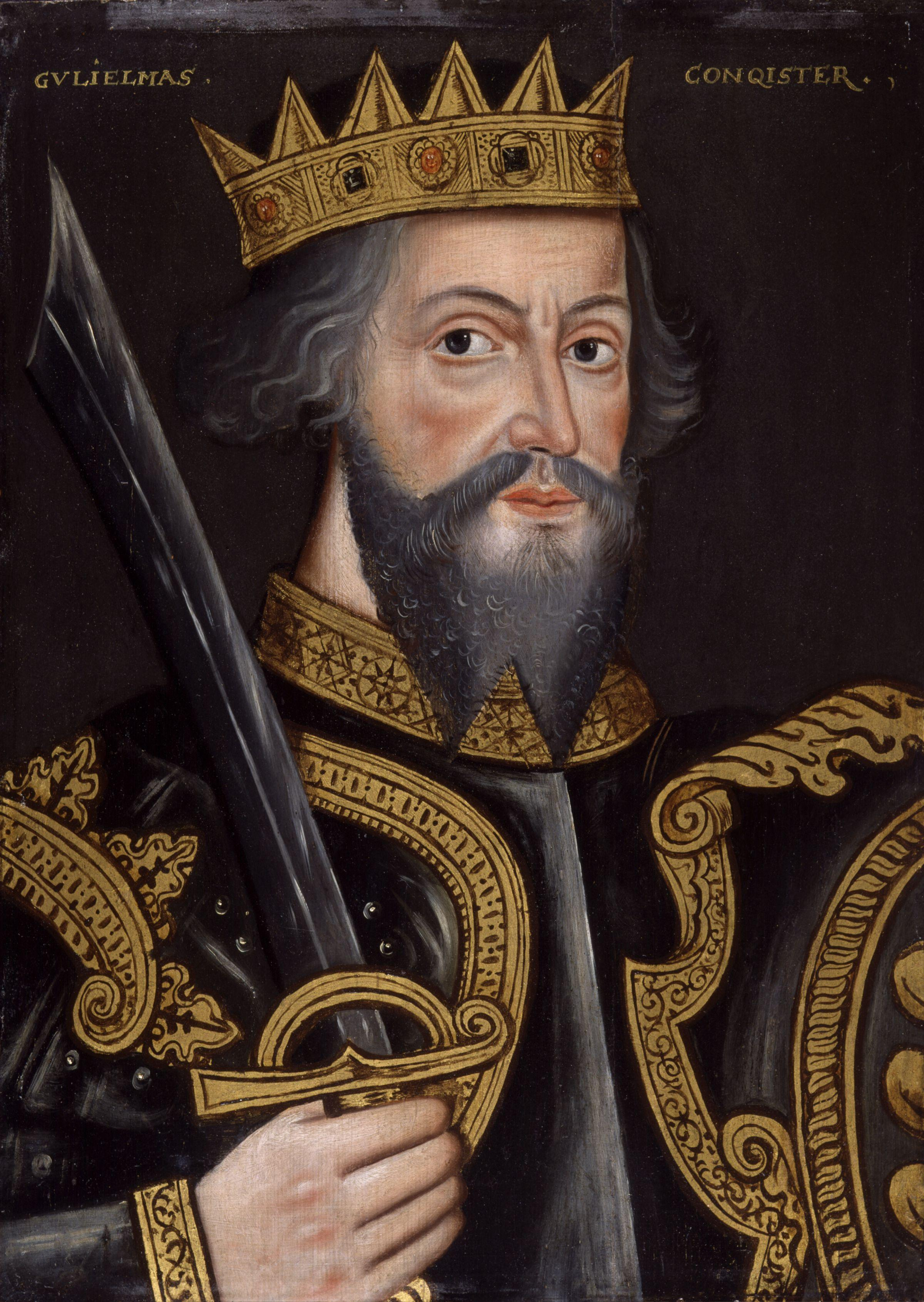
King William I "The Conqueror" OF NORMANDY of England 1956
- Born: Abt 1028, Falaise, Calvados, Normandy, France 1956
- Christened: 1028, Falaise, Calvados, Normandy, France 1956
- Marriage (1): Queen Consort Matilda OF FLANDERS of England after October 1049 in Rouen, Seine-Maritime, Normandy, France 2173
- Died: 9 September 1087, Rouen, Seine-Maritime, Normandy, France about age 59 1956
- Buried: 2 October 1087, Caen, Calvados, Normandy, France 1956
FamilySearch ID: 9H17-VTZ
Find A Grave ID: 1948
General Notes:
British Monarch. William I, the first Norman King of England, ascended to the throne in 1066 shortly after the death of his second cousin, Edward the Confessor. Edward had no heir, but requested William to be his heir apparent to the throne. William was the son of the Norman Duke Robert the Magnificent and the unnamed daughter of a tanner. At age seven he became the Duke of Normandy. He married Matilia, daughter of the Count of Flanders, and to the union four sons and five daughters were born. Since the English Witan did not make him their first choice for King, he invaded England along with other armies, conquering the newly appointed King Harold Godwinson and his Saxon army at the Battle of Hastings, thus winning the throne and the name of William the Conqueror. He was crowned on Christmas Day 1066 in Westminster Abbey. The English government became much more stable during his 21-year reign. England adopted the culture of West European countries instead of those of the northern Scandinavian countries, feudal tenure of land was introduced, landowners started paying taxes to the king, and the English church was reorganized. He was considered a fair man, with only one man being executed during his time in power, but he strongly enforced the hunting-gaming laws and mutilated many for breaking them. William was injured at the siege of Mantes while fighting against his feudal overlord, the King of France. He died at Convent of St. Gervais near Rouen in Normandy. His third son Rufus was his heir becoming William II of England. His disappointed first son Robert became the heir of Normandy.
LifeSketch
William I (c. 1028 \endash 9 September 1087), usually known as William the Conqueror and sometimes William the Bastard, was the first Norman monarch of England, reigning from 1066 until his death in 1087. By 1060, following a long struggle to establish his throne, his hold on Normandy was secure. In 1066, following the death of Edward the Confessor, William invaded England, leading an army of Normans to victory over the Anglo-Saxon forces of Harold Godwinson at the Battle of Hastings, and suppressed subsequent English revolts in what has become known as the Norman Conquest. The rest of his life was marked by struggles to consolidate his hold over England and his continental lands, and by difficulties with his eldest son, Robert Curthose.
William was the son of the unmarried Duke Robert I of Normandy and his mistress Herleva. His illegitimate status and his youth caused some difficulties for him after he succeeded his father, as did the anarchy which plagued the first years of his rule. During his childhood and adolescence, members of the Norman aristocracy battled each other, both for control of the child duke, and for their own ends. In 1047, William was able to quash a rebellion and begin to establish his authority over the duchy, a process that was not complete until about 1060. His marriage in the 1050s to Matilda of Flanders provided him with a powerful ally in the neighbouring county of Flanders. By the time of his marriage, William was able to arrange the appointment of his supporters as bishops and abbots in the Norman church. His consolidation of power allowed him to expand his horizons, and he secured control of the neighbouring county of Maine by 1062.
In the 1050s and early 1060s, William became a contender for the throne of England held by the childless Edward the Confessor, his first cousin once removed. There were other potential claimants, including the powerful English earl Harold Godwinson, whom Edward named as king on his deathbed in January 1066. Arguing that Edward had previously promised the throne to him and that Harold had sworn to support his claim, William built a large fleet and invaded England in September 1066. He decisively defeated and killed Harold at the Battle of Hastings on 14 October 1066. After further military efforts, William was crowned king on Christmas Day, 1066, in London. He made arrangements for the governance of England in early 1067 before returning to Normandy. Several unsuccessful rebellions followed, but William's hold was mostly secure on England by 1075, allowing him to spend the majority of his reign in continental Europe.
William's final years were marked by difficulties in his continental domains, troubles with his son, Robert, and threatened invasions of England by the Danes. In 1086, he ordered the compilation of the Domesday Book, a survey listing all the land-holdings in England along with their pre-Conquest and current holders. He died in September 1087 while leading a campaign in northern France, and was buried in Caen. His reign in England was marked by the construction of castles, settling a new Norman nobility on the land, and change in the composition of the English clergy. He did not try to integrate his various domains into one empire but continued to administer each part separately. His lands were divided after his death: Normandy went to Robert, and England went to his second surviving son, William Rufus.
...
One factor in William's favour was his marriage to Matilda of Flanders, the daughter of Count Baldwin V of Flanders. The union was arranged in 1049, but Pope Leo IX forbade the marriage at the Council of Rheims in October 1049. The marriage nevertheless went ahead some time in the early 1050s, possibly unsanctioned by the pope.
...
Family and children
William and his wife Matilda had at least nine children. The birth order of the sons is clear, but no source gives the relative order of birth of the daughters.
1. Robert was born between 1051 and 1054, died 10 February 1134. Duke of Normandy, married Sybilla, daughter of Geoffrey, Count of Conversano.
2. Richard was born before 1056, died around 1075.
3. William was born between 1056 and 1060, died 2 August 1100. King of England, killed in the New Forest.
4. Henry was born in late 1068, died 1 December 1135. King of England, married Edith, daughter of Malcolm III of Scotland. His second wife was Adeliza of Louvain.
5. Adeliza (or Adelida, Adelaide) died before 1113, reportedly betrothed to Harold Godwinson, probably a nun of Saint Léger at Préaux.
6. Cecilia (or Cecily) was born before 1066, died 1127, Abbess of Holy Trinity, Caen.
7. Matilda was born around 1061, died perhaps about 1086. Mentioned in Domesday Book as a daughter of William.
8. Constance died 1090, married Alan IV, Duke of Brittany.
9. Adela died 1137, married Stephen, Count of Blois.
10. (Possibly) Agatha, the betrothed of Alfonso VI of León and Castile.
There is no evidence of any illegitimate children born to William.
Death
William led an expedition against the French Vexin in July 1087. While seizing Mantes, William either fell ill or was injured by the pommel of his saddle. He was taken to the priory of Saint Gervase at Rouen, where he died on 9 September 1087.
https://en.wikipedia.org/wiki/William_the_Conqueror
Also substantiated by "The White Ship" by Charles Spencer, published 2020, pg 30-31.
PONS (-[before Oct 1066]). No information is known about Pons other than his name, which appears in the patronymics attributed to his five sons. It is assumed that he lived in Normandy. His absence from the Norman primary sources which have so far been consulted in the preparation of this document suggests that he was of lowly birth. His absence from English records suggests that he died before the Norman invasion in England in 1066. m ---. The name of Pons´s wife is not known. Pons & his wife had [six] children:
Walter
Drogo
Richard
Simon
Osbern
High
From Geni.com
Noted events in his life were:
1. He served in the military on 14 October 1066 in , , East Sussex, England: Commander of the Norman Army at the Battle of Hastings. 2173
2. Coronation: on 25 December 1066, in Westminster, City of Westminster, Greater London, England. 2173
3. Clan: House of Normandy,,. 2173
4. Title of Nobility: King of England,,.
5. Title of Nobility: Duke of Normandy,,.
William married Queen Consort Matilda OF FLANDERS of England, daughter of Baudouin V DE FLANDRE Comte de Flandre et Hainaut and Dutchess Consort Adèle DE FRANCE of Normandy, after October 1049 in Rouen, Seine-Maritime, Normandy, France.2173 (Queen Consort Matilda OF FLANDERS of England was born on 24 November 1031 in , French Flanders, Hauts-de-France, France 1956, christened in Caen, Calvados, Normandy, France,1956 died on 2 November 1083 in Caen, Calvados, Normandy, France 1956 and was buried on 8 November 1083 in Caen, Calvados, Normandy, France 1956.)
|